Reference Guide
Live Mode
The Live mode in JazzPianoLab allows you to explore and practice without restrictions. It's designed to give you complete freedom while providing helpful visual feedback and guidance.
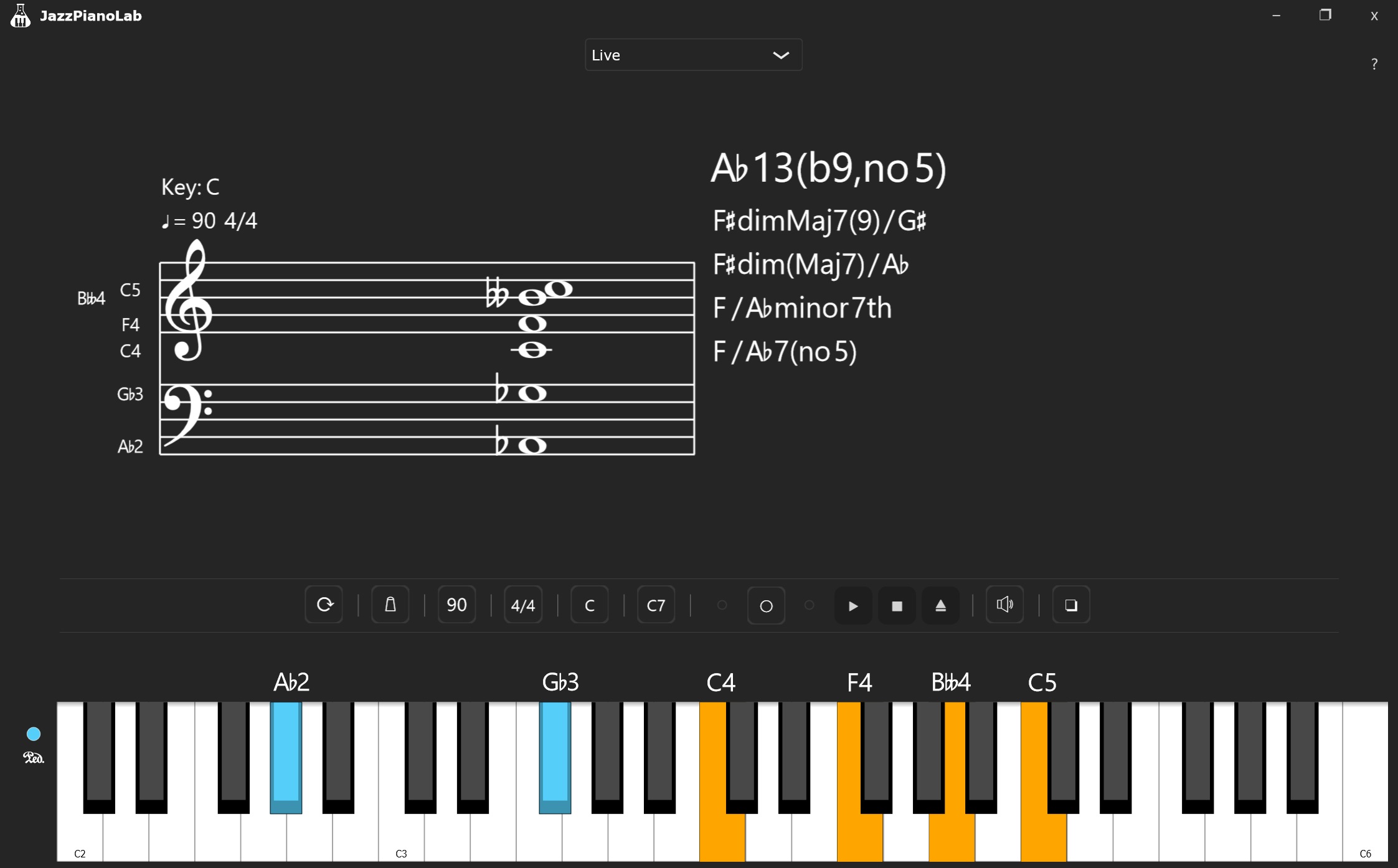
Getting Started
To access Live mode, simply click on "Live" from the main menu. In this mode, you can:
- Play freely on your MIDI keyboard or the on-screen piano
- See real-time chord identification as you play
- Choose Chord Profile to customize your playing experience
- Use the built-in metronome to practice with timing
- Record your performances for review
Toolbar Controls
The Live mode features a comprehensive toolbar with controls to adjust your playing experience:
MIDI Controls
- MIDI Reset: Sends MIDI reset messages to stop all currently playing notes and reset all controllers. Useful if you experience "stuck" notes.
- VST3 Instrument Mute: Toggle button to quickly mute/unmute the current VST3 instrument without changing other settings.
Metronome Controls
- Enable/Disable Metronome: Toggles the metronome on or off.
- Set Tempo: Opens a modal window where you can specify the beats per minute (BPM) for the metronome.
- Set Time Signature: Opens a modal window to configure the time signature (e.g., 4/4, 3/4, 5/4, etc.) used by the metronome.
Music Theory
- Set Current Key: Opens a modal window to set the current major key, which affects how chord symbols and note names are displayed, particularly regarding enharmonic equivalents (e.g., whether to show F# or Gb).
- Select Chord Profile: Opens a modal window to select the current Chord Profile to use, which affects the Chord Identification feature and how chords and chord variations are displayed.
MIDI Recorder
- Record: Starts recording your MIDI performance.
- Play: Plays back your most recently recorded performance.
- Stop: Stops the current recording or playback.
- Save to File: Opens a dialog to save your recorded performance as a standard MIDI file.
Display Options
- Windowed Mode: Toggle button that attaches/detaches the Virtual MIDI keyboard from/to the application's main window. When detached, you can position the keyboard independently, which is useful for multi-monitor setups or to optimize screen space.
Controls and Features
The Live interface provides several components to enhance your practice:
Tool Bar
As described in the Toolbar Controls section above, the tool bar provides quick access to essential functions like MIDI reset, metronome controls, key selection, recorder controls, and display options.
Musical Staff
The musical staff displays real-time information about your playing and current settings:
- Current Tempo: Shows the current beats per minute (BPM) setting
- Time Signature: Displays the current time signature (e.g., 4/4, 3/4)
- Metronome Status: Visual indicator showing whether the metronome is enabled or disabled
- Current Key: Shows both the name of the selected key and its corresponding key signature (accidentals) on the staff
- Note Display: Shows pressed keys as notation on the staff in real time
- Note Names: When enabled, displays note names to the left of the staff for each pressed key
Virtual MIDI Keyboard
- Key Visualization: Displays key presses in real-time with customizable colors
- Note Names: When enabled, displays the names of notes above each key
- Sustain Pedal Indicator: Shows the status of the sustain pedal on either the left or right side of the keyboard (if configured to be displayed)
- Pedal-Sustained Notes: Visually indicates which notes are being sustained by the pedal
Other Features
- Chord Display: Shows identified chords as you play according to your chord profile and chord identification settings
- Windowed/Attached Mode: Flexibility to have the MIDI keyboard attached to the main window or as a separate floating window
Tips for Live
- Use the chord identification feature to learn new chord voicings
- Use Chord Profiles to customize your playing experience
- Practice with the metronome to develop steady timing
- Record yourself and listen back critically
- Experiment with different keys and time signatures to expand your musicality
- Customize the visual settings to suit your learning style
- Use tool bar to quickly access different settings